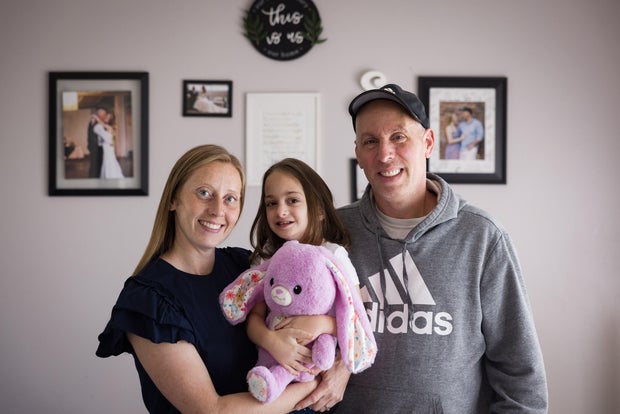
Ollie Super has been in and out of cancer treatments since being diagnosed with neuroblastoma while in foster care as a toddler. Now the 8th and 2nd graders are working on it again. Her cancer returned late last year.
Ollie’s parents, who adopted her in 2020, tried to enroll her in a clinical trial using CAR-T cell therapy, which genetically reprograms a patient’s white blood cells to help fight cancer, at UNC Health in Chapel Hill, North Carolina, an hour and a half drive from Eden’s home.
Her mother, Brittany Super, said it was Ollie’s “last option.”
But Super recalled being told the bad news by UNC Health’s finance office in early March. The new state insurance policy for children in foster care would not cover treatment costs.
In December, Olly became one of the hundreds of thousands of children nationwide who are eligible for foster care and enrolled in a special type of public health insurance. The insurance, known as a specialty managed care plan, is part of Medicaid, a federal-state program that covers medical costs for people with low incomes and disabilities.
Alison Lee Eisley appears on KFF Health News
North Carolina is one of 14 states with such specialized foster care programs, according to the National Academy of State Health Policy. Plans vary by state, but each aims to expand coverage to children in the foster care system and children adopted from the foster care system, such as Ollie and her siblings.
But like other states that have struggled to add such plans, families in North Carolina face hurdles in accessing care. Thousands of doctors covered by Medicaid were not included in the special plan, which went into effect Dec. 1 and would cost the state $3.1 billion over four years. This has left parents and guardians of children adopted from the system scrambling to find new health care providers or new insurance.
In North Carolina, insurance planning stumbles add another layer of complexity to health care issues. Like many others, the state is already grappling with more uncertainty than expected. Medicaid reduction In response to Congressional Republicans’ One Big Beautiful Bill Act. Another Medicaid funding shortfall has also prompted providers to lower reimbursement rates.
Texas, which created the plan 18 years ago, has found in recent years that foster families also have trouble finding doctors who accept their insurance. In Florida, researchers there reported in 2016 that there was a shortage of health care providers willing to accept the plan.
Illinois’ plan triggered an investigation by the Centers for Medicare and Medicaid Services into the lack of access to care. The study concluded that California’s plan does not provide adequate mental health services to children. Georgia’s access problems have alarmed state officials enough to prompt pending legislation that would require children to be removed from the plan and placed back in other Medicaid plans.
But special programs like this one for children in foster care continue to garner attention. Karen VanLandeghem, senior director of child and family health at the National Academy for State Health Policy, said four states have launched their own plans in the past five years, and more states are likely to adopt them soon.
Only a handful of states publish numbers showing the success of these programs, according to Medicaid policy analysts. Therefore, it is difficult to know why problems occurred during deployment or whether access to care improved. That makes the plan risky, said Andy Schneider, a research professor at Georgetown University’s Center for Children and Families.
“States that go in this direction are just experimenting unless they have the data to support it,” Schneider said. “They’re putting all their eggs in one basket, so you have to be very careful.”
Rough development
North Carolina’s special insurance plan for foster children ran into problems on the day it launched.
The state automatically enrolled Ollie and about 32,000 others in a special plan called Healthy Blue Care Together. North Carolina officials said the program will improve access to health care for foster children, who often have complex medical needs and are frequently moved.
But foster families soon began hearing that their health care providers weren’t insured, according to several families who described their struggles to get their children covered.
UNC Health, one of North Carolina’s largest health care providers and a state-run health system with about 4,400 doctors, initially had no intention of signing up to the state’s plan, which is why it told the supers that Ollie’s CAR-T cell treatment would not be covered.
After more than two months of impasse for families, UNC Health finally reached an agreement in mid-March with Blue Cross Blue Shield of North Carolina, which runs the plan.
However, some North Carolina doctors still do not accept Healthy Blue insurance.
Melanie Bush, interim deputy commissioner for North Carolina’s Medicaid program, said her office is pressuring Healthy Blue to expand its network even though it already has a “sufficient” number of providers. The North Carolina Department of Health and Blue Cross Blue Shield did not respond to KFF Health News’ questions about the number of health care providers covered by the new plan.
“We welcome eligible providers who wish to participate,” said Sarah Lang, spokeswoman for Blue Cross Blue Shield of North Carolina.
Other problems continued. Pediatric doctors are struggling to track patients’ medical histories as thousands of medical records are migrated to a statewide database managed by Healthy Blue, foster care advocacy groups and pediatricians said. Parents reported having trouble viewing their health records and being locked out of online portals. Some did not have access to prescriptions. The surgery was delayed. Your appointment has been cancelled.
“No matter what your plans are, network management is an ongoing process,” Lang said.
All of this meant added paperwork and heartache for caregivers of children like Olly with complex medical needs, which the plan was most designed to help.
get ready
Cancer has been a part of Ollie’s life since he was two years old. She was in the process of being adopted from a foster care facility when she started chemotherapy and radiation treatments and subsequently underwent two stem cell transplants, Super recalled.
Surgeons inserted a temporary tube into a vein near her heart and attached a feeding tube to her abdomen. As the treatment intensified, her hair fell out and thin layers of skin peeled off, forcing her new family to wear surgical gowns and gloves when they wanted to be close.
“She doesn’t remember anything in her life other than going to the doctor or being hospitalized,” Super said.
brittany super 
Olly still has a port in his chest so he can access intravenous medication whenever he needs it, and his monthly doctor’s visits are now reduced to once a week. During a visit to the emergency room in mid-March, doctors told Super that her daughter’s cancer had spread. Olly will need further chemotherapy before his body is ready for more advanced treatments.
But after being thrown into uncertainty for more than two months, Supers still feels a sense of relief. They are preparing for a round-trip drive for CAR-T cell therapy treatment in Chapel Hill. And they’re grateful, even if it means Ollie will spend at least five more weeks in the hospital.
Reliable health insurance is essential for Olly, and Healthy Blue leaders said they are talking to doctors, parents and others to make sure the plan works. Her mother says her surgery comes with a multi-million dollar price tag, but the bill will be covered seamlessly, allowing the family to focus on Ollie’s treatment.
“Her biggest challenge will be the first few months of the study,” said Super, who is aware that side effects of the therapy include fever, fatigue and confusion. “But then we hope that the CAR T cells will do their part and fight the cancer so she can continue to live a playful and active life.”
Alison Lee Eisley appears on KFF Health News 
That means they hope the girl will be able to be home more often with her five siblings and three dogs, including Olly’s favorite border collie mix, Remy.
Super said her daughter is enjoying the precious moments of “being a kid and doing childish things.”
KFF Health News is a national newsroom that produces in-depth journalism on health issues and is one of our core operating programs. KFF — An independent source for health policy research, polling, and journalism.
#foster #child #insurance #plan #threatened #8yearolds #cancer #treatment