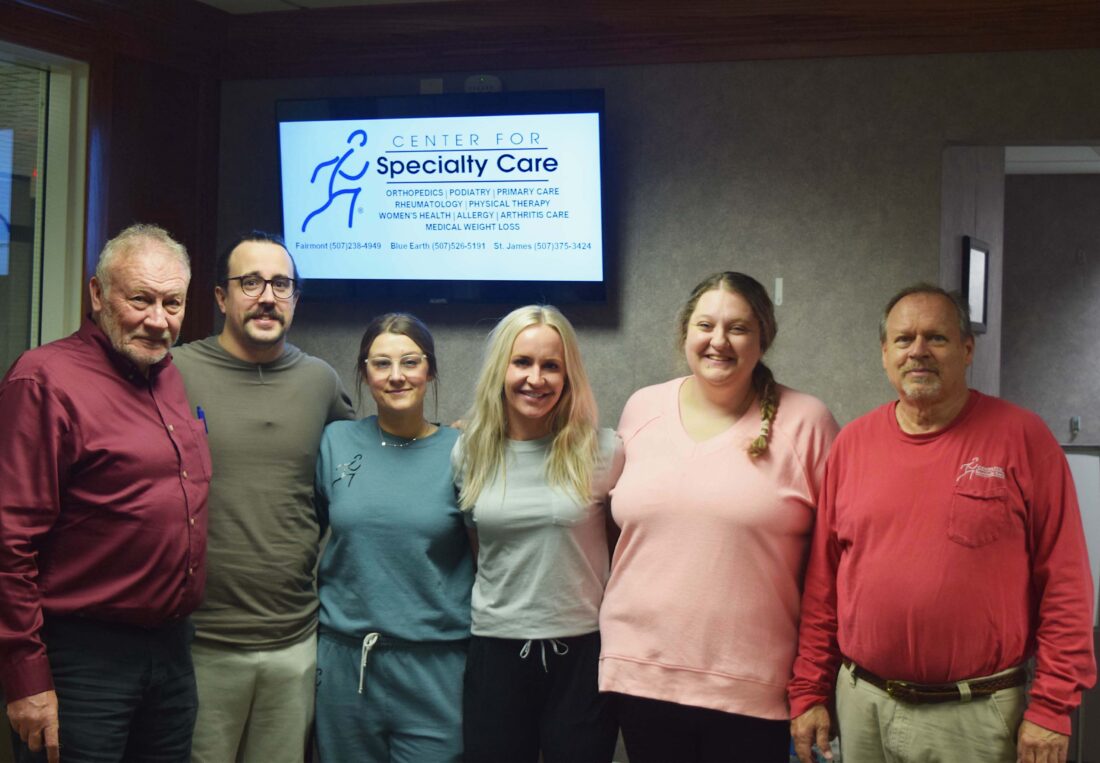
Above: Dr. Corey Welklin and his team, Tom Tow, Abby Thomas, Kayla Olson, Amanda Guthmiller and Thomas Carpenter at the Fairmont Specialty Care Center on Tuesday. It was the last day of medical treatment at Fairmont.
FAIRMONT – In 1990, Dr. Cory Welklin opened a clinic in Fairmont and on Tuesday officially closed his specialty treatment center at Victoria State Crossing in Fairmont. Although the multifaceted decision was not easy to make, Welklin acknowledged that he has had many good years in his 36 years of caring for patients in the Fairmont area.
Welklin was born in a Fairmont hospital and raised on a farm near St. James.
“This has always been home,” he said.
He originally wanted to go into farming, but his father encouraged him to pursue other things, particularly becoming a doctor.
After high school, I attended Gustavus Aldolphus College and then medical school, which included five years of specialized medical training. He is a certified orthopedic surgeon.
“When I decided I wanted to move back to the area, Fairmont Hospital gave me an interest-free loan to start my practice because the medical center didn’t want to hire an orthopedic surgeon,” Welchlin explained.
He was in independent practice and participated in building partnerships. He had to build his own business and medical records team and started with just three employees.
“In the late 1990s, when Mr. Mayo bought the clinic and eventually took over the hospital, the doctors at the clinic at the time, myself, the dentist, and other people who were not employees of the medical center were forced to retire within two years. So we built this building,” he said of the Victoria State Crossing building.
Welchlin said the partnership constructed the building with tax increment financing (TIF) from the city.
Around 2000, they moved into a newly completed building, and at that time Werklin said his practice exploded.
“We went from a few employees to 130 employees at our largest. We have five orthopedic surgeons, three general surgeons, several family medicine physicians, an internist. At one point we had six nurses and covered about 10 different communities from as far north as Willmar to as far west as Pipestone,” Welchlin said.
Things were going very well for many years, but some significant events led to a decline in business.
“Obamacare hit, then COVID hit. People were retiring, people were moving, people were coming and going, incomes were going down, and things just got tighter and tighter,” Welchlin said.
The impact of the new coronavirus has been particularly severe, with elective surgeries, including many that had been performed at specialty care centers, being unable to be performed, leaving only emergency surgeries.
“We would be going months without surgery, and the PPP (Paycheck Protection Program) funding was not enough to have enough staff and keep the lights on,” Welchlin said.
He said although he was given leeway, the other shoe dropped when his architectural partner notified Welklin in mid-January that he had to vacate the building by April 1, and he was never given the chance to turn the corner.
“You can’t make big changes in health care in a month or two. No matter where you go, no matter where you interview, it takes weeks to get credentials, privileges, insurance companies, etc.,” Welklin said.
Although his office space has shrunk in recent years, eight rooms in the building are still being used as clinics, which his staff cleared out last week.
Werklin said he’s sad and disappointed that his practice is ending here, but he’s grateful for what he’s had so far.
“I’m proud and happy with what we’ve provided over the years. I think we’ve done a pretty good job of serving patients, getting good outcomes and keeping people local,” Welchlin said.
In addition to Obamacare and COVID-19, Welchlin acknowledged that changes in the local medical landscape are impacting his practice, and that other hospital systems in the area, Sanford Hospital and Avera Hospital, are doing a better job with orthopedic referrals.
He pointed out that when he started, there weren’t many options for orthopedic treatment, and his practice was the answer, which led to his boom. He was able to help many patients during that time and is proud of all he was able to provide.
“It’s becoming very rare for my kind of practice to survive or thrive. It’s becoming increasingly difficult for a variety of reasons. Consolidations continue and they require significant financial support,” Welchlin said. “When I started my practice in 1990, the hip and knee replacements we performed required a one-week to 10-day hospital stay, but in the last 10 to 15 years, we have performed hip and knee replacements on an outpatient basis, if the insurance company allows it. , and they were able to go home the same day. Our preoperative, intraoperative, and postoperative care is excellent in pain management, patient education is excellent, and our outpatient care is excellent,” Welchlin said.
Because that’s what’s happening, Welklin said it’s saving people a lot of money in health care costs and he thinks they’ve done a good job in steering the community in that direction.
“When I started this practice, we had an overnight room that we used for hip and knee replacements to check on patients for the first few years. But we haven’t used that room for probably the last 10 years because everyone we talk about going home goes home and their pain can be controlled with oral medications. We check on them the next day and start treatment within two days,” Welchlin said.
He said people now have to travel to Mankato, St. Peter, Rochester or, in some cases, Blue Earth to receive the same treatment they would have received in an outpatient setting.
Welchlin is disappointed in the closure of the Fairmont site, but he still practices at the Buffalo Center in Iowa. He explained that a community group in Buffalo Center approached him a few years ago after Mercy Hospital withdrew, but they had a nice clinic building and no one to lead the medical practice.
“You have to be a medical professional to run a medical practice. You can’t be just anyone,” Welchlin explained.
He said he has a significant number of employees and patients from the area and plans to hire primary care providers in addition to orthopedics and general surgery.
Buffalo Center’s specialty and primary care center remains open and doing well, and Welklin said he hopes to grow the center over the next few years.
Welklin has no plans to retire because of the Fairmont site closure, and is instead considering his options. He has the privilege of performing surgeries in Blue Earth and Madelia, and plans to reach out to hospitals in Algona as well. He is also considering the option of temporarily filling in for a surgeon on leave.
Starting today, the Fairmont Specialty Care Center will be closed, but phone numbers will be redirected to the Buffalo Center site and answered five days a week.
#Center #Specialty #Cares #Fairmont #site #closed