How much influence does the people’s voice actually have in the People’s House?
On Town Meeting Day, eight towns in Vermont loudly urged Congress to introduce legislation that would launch a multi-tiered universal health care program called Green Mountain Care.
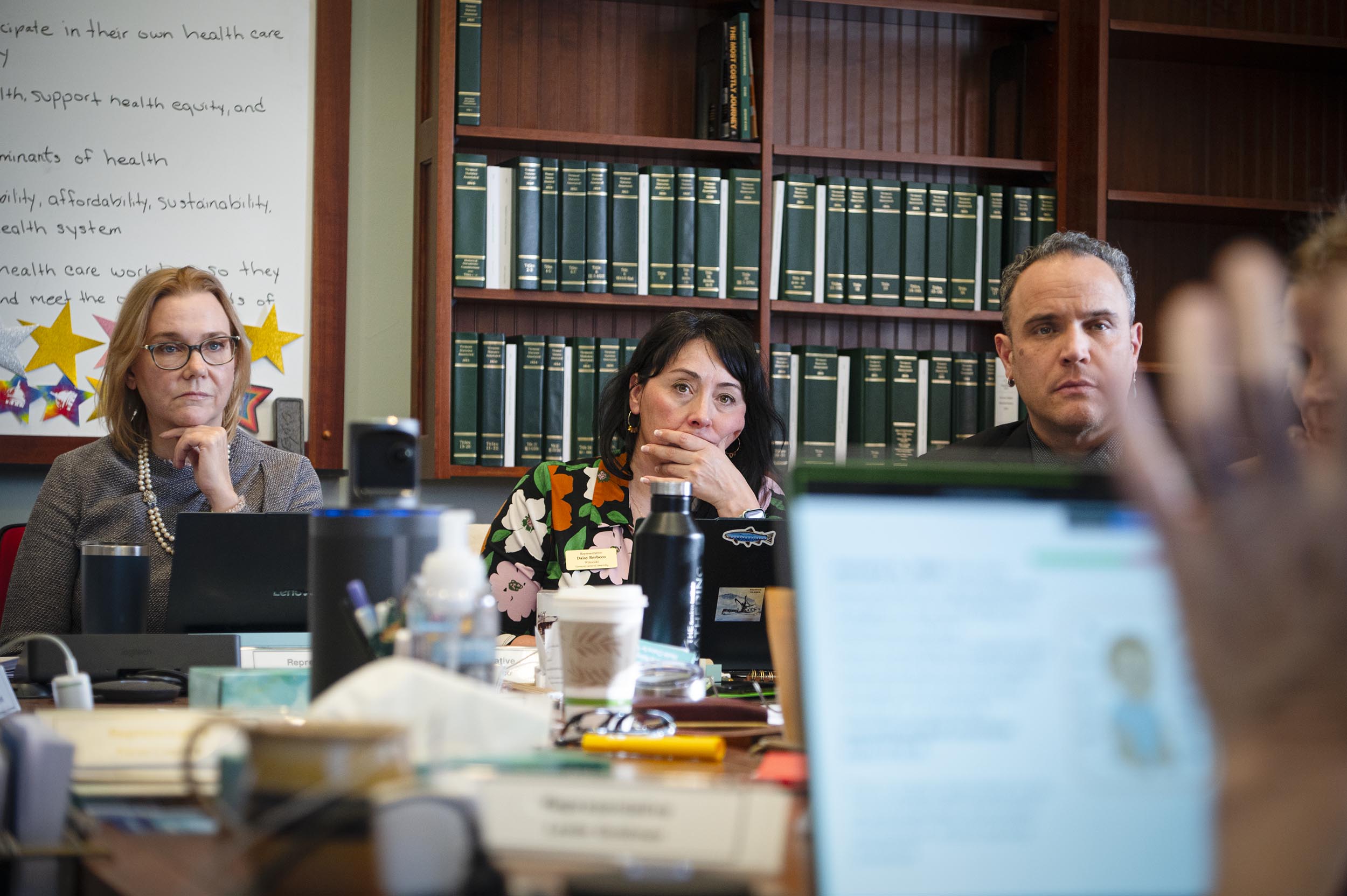
This bill, H.433, has not passed the crossover deadline and has no chance of becoming law this year. But members of the House Health Care Committee withdrew the bill as soon as Wednesday, forcing Legislative Counsel Jennifer Kirby to explain the bill’s language — at least “for educational purposes,” said Rep. Alyssa Black, D-Essex Town, the committee’s chair.
Still, activists supporting the Town Meeting Day resolution saw promise in the lawmakers’ approach to the stalled bill.
“I’m encouraged,” Dr. Jack Mayer, a primary care physician who testified before the committee Wednesday, told VTDigger. He was one of the driving forces behind bringing the resolution to voters at Town Meeting.
“Ultimately, the intent of the resolution was, let’s bring this to the floor, let’s discuss it, let’s consider it, let’s have a conversation,” he said.
Lawmakers on the House committee asked technical questions, such as what preventive services would be included in Green Mountain Care and how the state would fund such a program. They wanted to poke fun at these concerns, but also to inform their work on this year’s big primary care bill, S.197, which was just sent to committee by the Senate.
This bill, which devises a payment system that would allow patients to access primary care without having to pay for each service, could very well be a means to keep the spirit of universal care, or at least universal primary care, alive.
“I think things are starting to change,” Meyer said. “I think there’s a growing recognition on the part of Congress that what we’re doing is unsustainable, and for a variety of reasons it makes sense to start embracing the concept of publicly funded primary care.”
In particular, Mayer hopes the bill will include research that could examine the financial realities of implementing a universal primary care system. For him, it would be the first sign of serious change.
The committee largely shared his enthusiasm and desire to further explore universal care, and were more than amused by him on this April Fool’s Day.
“There’s a running joke on this committee that if you don’t believe in universal health care when you come on this committee, by the time you’re done you’ll believe in it,” Black said.
— Olivia Giger
Only those in the know know
The Vermont Labor Relations Board has ordered Gov. Phil Scott’s administration to “rescind” a controversial requirement for state employees to return to physical offices three days a week.
The commission, a non-judicial body that decides on state employees’ labor grievances, said in a decision Wednesday that the state “refused good faith bargaining and obstructed employees from exercising their rights” in requiring in-person work.
Scott called the decision “disappointing but not surprising” during his weekly news conference Wednesday, saying board members are “focused on workers.”
Scott appointed the committee members himself, but appeared to refer to the committee’s legal guidelines, telling reporters that the “parameters” governing the committee’s composition limited his choices.
Earlier in the day, his office released a statement condemning the state Labor Relations Board and its decision, calling the body “broken.”
The state has already filed a notice of appeal with the Vermont Supreme Court, officials said.
The Vermont State Employees Association called the decision a “remarkable victory” in an email to members Wednesday. Union leadership said in its email that the order protects “union members’ right to have a say in the terms and conditions of their employment.”
Read the full text here.
— Theo Wells Spackman
Rep. Brian Cena (D-Burlington) pulled his Airpods out of his jacket pocket. “Soon, very soon, you’ll be able to pick this up and put it in your ear, and it will link to your brain. We’re very close to that.”
He demonstrated this Wednesday before the Senate Health and Human Services Committee with his Neural Privacy Act, H.814, which aims to establish standards and rights to protect people’s privacy and humanity from the ever-encroaching influence of artificial intelligence.
The bill would establish an Artificial Intelligence Advisory Commission to make recommendations on how the state uses artificial intelligence in health care, education, state and local budgets, and more.
“As scary as it sounds, it’s real and there’s nothing we can really do to stop it at this point,” Sina said of AI technology connecting to every aspect of life.
Sen. Ginny Lyons, D-Chittenden, said her committee will likely take up the bill. Its central message, that AI should improve the human condition, not undermine it, is an important one, she said.
— Olivia Giger
On the move
On Wednesday, senators passed S.193. The bill would create a facility for people charged with violent crimes but temporarily found incompetent to stand trial or found not guilty by reason of insanity.
29 senators voted in favor of the bill. Sen. Tanya Vihovsky (D) of Chittenden Center was the only lawmaker to vote against it.
Vykhovsky earlier voted against the bill in the Senate Judiciary Committee, saying during the meeting that he did not want the Vermont Department of Corrections to run the facility.
Under the bill, a person would only be referred to a facility if they do not meet the clinical criteria for admission to a psychiatric hospital but could still be considered a danger to others.
Gov. Phil Scott and his cabinet urged lawmakers to move forward with the bill. For years, no legislation containing similar measures has materialized.
“We need a safe environment where violent offenders with mental illness, developmental disabilities, and substance use disorders can receive appropriate care and, if possible, be restored to competency to stand trial,” Scott’s attorney, Jay Johnson, said at the governor’s press conference last month.
— charlotte oliver
#Voters #Town #Meeting #asked #lawmakers #universal #health #care #bill #change #Montpelier #VTDigger