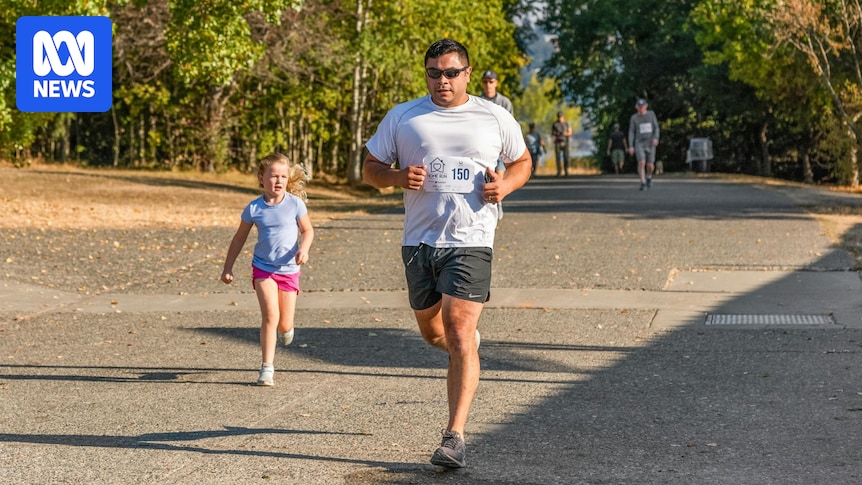
If you love running and your child has expressed an interest in running, you may be wondering when they can start.
Hunter Bennett, a senior lecturer in sports science at the University of Adelaide, said children who engage in physical activity such as running have a reduced risk of childhood obesity, improved heart health and mental health and are more likely to remain active as adults.
While there’s no hard and fast rule for when kids can start jogging or running long distances, Dr. Bennett says there are some things to consider to determine if they’re ready.
Difference between running and “running around”
When children engage in play-based running, like a game of tag, their movements are unstructured and involve short bursts of intensity, Dr. Bennett explains.
“The movements are more varied…they’re doing sideways movements…jumping, landing, sprinting.
”[These] It allows for the development of other qualities that really matter, such as strength, power, bone density, and social skills. ”
Dr. Bennett says jogging or running long distances is repetitive exercise and requires continuous activity over long periods of time.
That doesn’t mean running is bad, he adds, just that you’re at higher risk for “overuse injuries” such as shin splints. And children don’t have the same variety of benefits.
That’s why it’s important for children to be aware of how far and for how long they run. And it’s not a replacement for play-based activities, Dr. Bennett says.
David Rubans, director of the Global Sport and Movement Collaborative at Newcastle University, describes play-based running as a kind of “voluntary interval training” that comes naturally to children.
“The games children play are sporadic; [are] They don’t just train continuously unless coached.
“They move because it’s fun and they do it with friends and play games.”
Young children, in particular, are less motivated to participate in anything marketed as exercise or fitness, he says.
At what age can my child start running?
Although the level of readiness varies from child to child, Dr. Bennett says that children under 5 do not need “structured exercise.”
“They could be even older, like 6 or 7 years old, so I would be a little hesitant to put strict measures in place.”
He says an indicator of when children are ready to engage in more structured activities, such as running, may be when play becomes less “natural or organic” than it used to be.
For example, “this could be something like going for a walk as a family and doing a run in between, or even a short running race. You don’t have to run every kilometer,” says Dr. Bennett.
He says the rough guidelines for ages 7 onwards are:
- From 7 to 9 years old: Children can start running for 20 to 30 minutes up to three times a week.
- From 10 to 12 years old: Children can increase this to 20 to 40 minutes of running three to five times a week. However, the maximum mileage is approximately 5km.
- From 13 to 17 years old: Teens can progress in running on a more individual basis.
How to minimize the risks of running
Dr Bennett says there’s nothing “inherently dangerous” about running for kids, but it’s important to make sure they build up their fitness and strength over time.
“If you want to run a 5K, don’t just say, ‘Let’s do it.’ Gradually increase the time between your walks and runs.”
Professor Rubans says the message should be “incremental and progressive”.
”Don’t expect too soon.”
He says the biggest risk is that children will become reluctant to exercise.
Dr Bennett warns that children who specialize in certain activities early in life experience “much higher rates” of burnout.
“It certainly piques their interest, whether it’s distance running or sports, we see that.
“We really want kids to do a variety of activities, develop a variety of physical skills, and be exposed to a variety of activities as they grow into adulthood.”
He also warned that forcing children into any kind of sport or activity could lead to them “disengaging from physical activity more generally”.
Have fun and stay positive
Professor Louise Baur, a child and adolescent health expert at the University of Sydney, says there are a variety of activities parents can model to make running-based exercise fun for children.
“Kids will enjoy games like tag, chase and red light/green light.
“Think of different types of activities: bushwalking, dance moves, treasure hunts, obstacle courses, dog walks, water gun fights, shooting hoops, trampolines, etc.”
How you talk about running and why you run are also important, says Dr. Bennett.
“Let’s make it a really low-stress, low-pressure environment.”
Professor Rubans says the focus is on running together to connect and socialize.
He suggests choosing a comfortable environment in nature (not like a 35-degree day).
#start #running #child